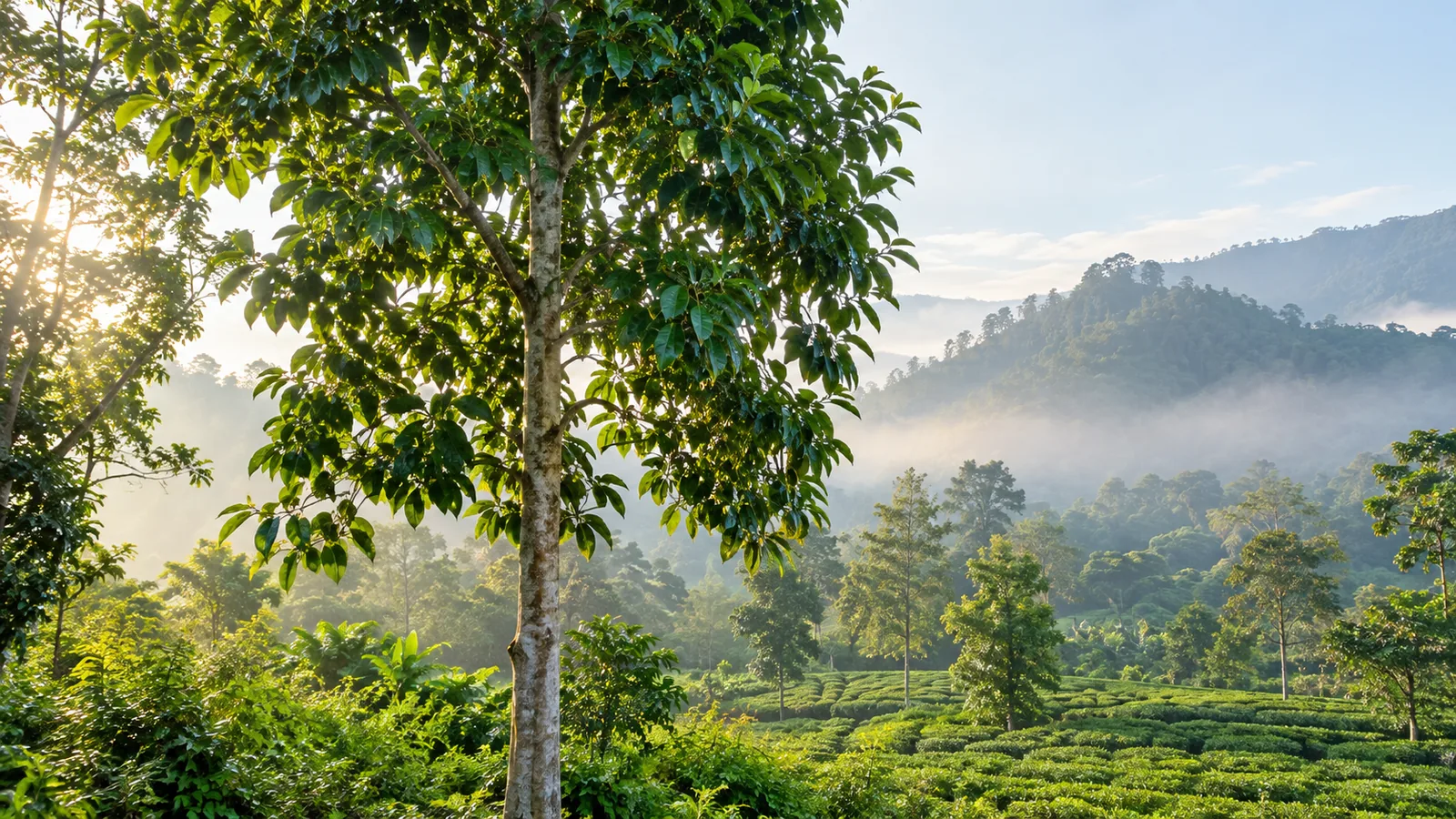
The agarwood tree (also called the oud tree or agar tree) is the Aquilaria tree of South and Southeast Asia, and oud is the dark, fragrant resin it makes only after it is wounded and infected.
A healthy agarwood tree has no oud in it at all.
Most people imagine a forest of “oud trees” where every log smells like a majlis. That is not how it works. The wood of a healthy Aquilaria tree is pale, light and nearly odourless. Only when the tree is hurt — by insects, a broken branch, lightning or fungi — does it fight back by filling the wound with a dark resin. That resin-soaked wood is agarwood. In the wild, studies put it at only about 7–10% of trees, which is why real oud is one of the most expensive natural materials on earth, and why so many shops sell fakes.
This guide covers everything you need to know about the agarwood tree in plain words: what it looks like, how oud forms inside it, where it grows (including India’s Northeast, where our shop’s name comes from), wild vs cultivated trees, why it is protected, what an agarwood tree and its wood really cost in 2027, whether you can grow one in the UAE, and how the tree’s origin changes the oud you burn at home. At the end, we show you how to buy honest agarwood from us in Deira.
“Is oud from a special tree? Does every agarwood tree have oud inside, and why is the price so different from one shop to another?”
— a common question from first-time oud buyers
Quick answer
Oud comes from the agarwood tree (Aquilaria, about 21 species), a tall evergreen tree native to Northeast India, Bangladesh, Southeast Asia and Papua New Guinea. The tree only makes oud resin after an injury and infection, and only about 7–10% of wild trees carry it. Today most new agarwood comes from planted trees that are deliberately inoculated. All Aquilaria species are protected under CITES Appendix II, so legal trade needs permits. A sapling costs very little, but a tree is only valuable for the resin inside it; good agarwood chips sell for roughly AED 75–420 per 12 g in Dubai, depending on grade. (Prices are a guide only and can change at any time.)
In This Guide
- What is the agarwood tree?
- The agarwood tree at a glance
- How to identify an agarwood tree
- Does the agarwood tree itself smell of oud?
- How does oud form inside the tree?
- How long does an agarwood tree take to make oud?
- Where does the agarwood tree grow?
- The agar tree in India’s Northeast: Assam and Nagaland
- Wild vs cultivated agarwood trees
- What is inoculated agarwood, and is it “real”?
- Is the agarwood tree endangered?
- Agarwood tree price 2027: sapling, tree and wood
- Can you grow an agarwood tree at home or in the UAE?
- Is planting agarwood trees a good investment?
- From tree to majlis: chips, dehn al oud and bakhoor
- How the tree’s origin changes the scent
- How to buy real agarwood with us in Deira
- Your agarwood buying checklist
- Frequently asked questions
1. What Is the Agarwood Tree?
The agarwood tree is any tree of the genus Aquilaria, part of the Thymelaeaceae plant family. Botanists accept about 21 species of Aquilaria. A few close cousins in the genus Gyrinops also make agarwood, but in the trade, when people say “agarwood tree”, they nearly always mean Aquilaria.
The same tree has many names, which is why searching for it can be confusing:
- Agarwood tree / agar tree – the common English and Indian name.
- Oud tree – from the Arabic oud (عود), used across the Gulf.
- Aloeswood or eaglewood – older English names (nothing to do with aloe vera or eagles).
- Gaharu / karas – Malaysia and Indonesia.
- Chen xiang – China; jinkoh – Japan.
The most important species for oud are Aquilaria malaccensis (India’s Northeast, Bangladesh, Malaysia, Indonesia), Aquilaria crassna (Cambodia, Thailand, Vietnam, Laos) and Aquilaria sinensis (southern China). When you hear “Hindi oud” or “Cambodi oud” in a Dubai shop, it mostly points back to these trees and the places they grow.
Insider tip: the word “agarwood” means the resinous wood, not the tree. A shop selling “agarwood” should be selling dark, resin-filled wood, not plain Aquilaria timber. Keep that difference in mind and you will already be ahead of most buyers.
2. The Agarwood Tree at a Glance
| Feature | Agarwood tree (Aquilaria) |
|---|---|
| Other names | Oud tree, agar tree, aloeswood, eaglewood, gaharu |
| Plant family | Thymelaeaceae |
| Number of species | About 21 Aquilaria (plus a few Gyrinops) |
| Height | Usually 6–20 m; old wild A. malaccensis can pass 30–40 m |
| Native range | Northeast India, Bangladesh, Bhutan, Myanmar, Thailand, Cambodia, Laos, Vietnam, southern China, Malaysia, Indonesia, Philippines, Papua New Guinea |
| Climate | Warm and humid; about 22–43 °C, up to around 2,000 m altitude |
| Healthy wood | Pale, soft, light, almost no smell |
| Agarwood (resin wood) | Dark brown to black, heavy, oily, fragrant when warmed |
| Wild trees with resin | Roughly 7–10% |
| Protection | CITES Appendix II (all species); A. malaccensis is Critically Endangered on the IUCN Red List |
| Main products | Agarwood chips, dehn al oud (oud oil), bakhoor, perfume |
3. How to Identify an Agarwood Tree
An agarwood tree looks like many other tropical trees, so even farmers sometimes mix them up. Here is what to look for, based on botanical descriptions such as Singapore’s National Parks flora record:
- Trunk and bark: straight trunk with smooth, pale to dark grey bark that peels thinly; the inner bark is creamy white.
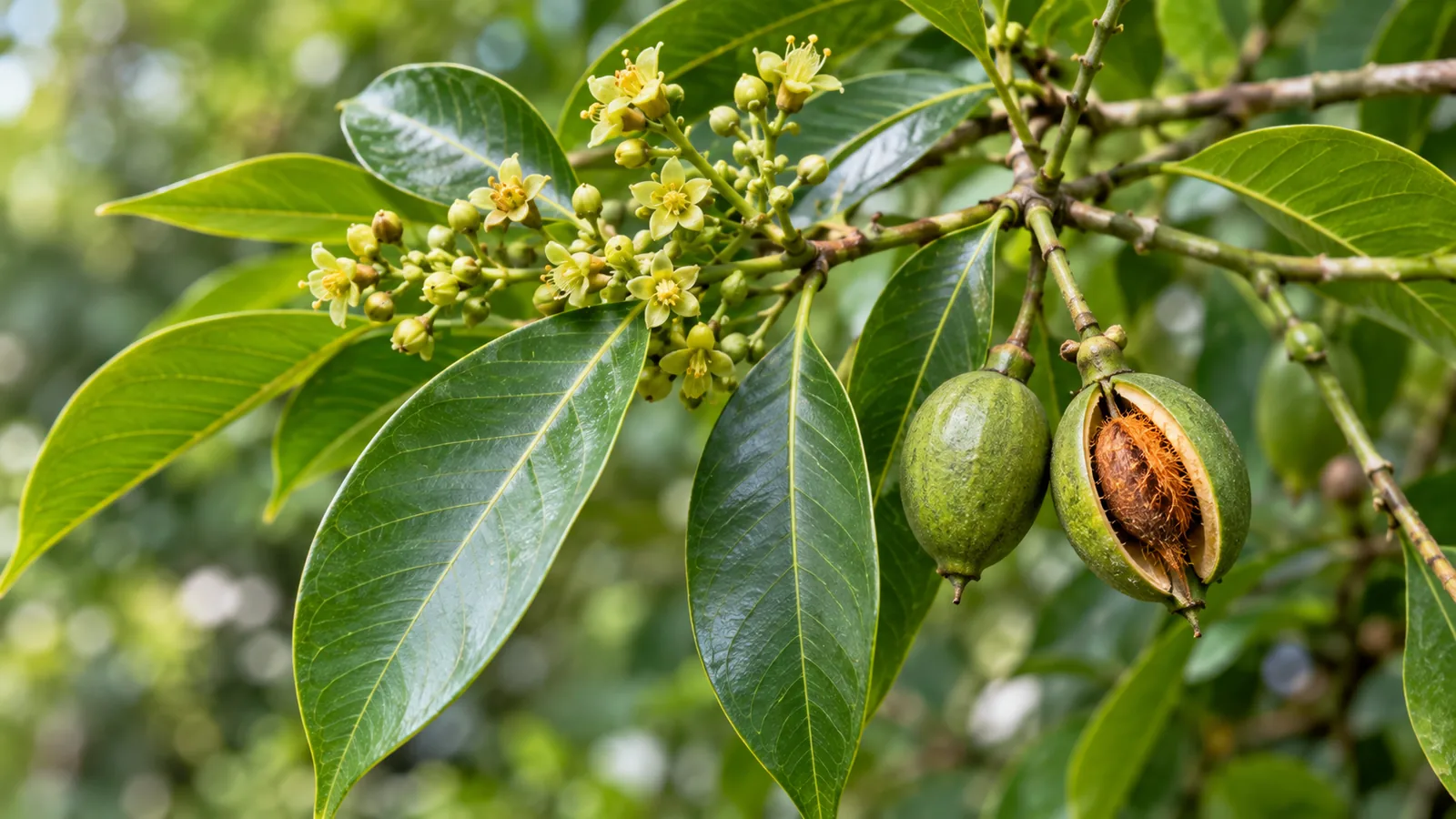
- Leaves: simple, glossy, oval to lance-shaped, about 6–12 cm long, with a long pointed tip and many fine parallel side veins.
- Flowers: tiny (about 5–6 mm), yellow-green and lightly fragrant, in small clusters.
- Fruit: green, woody, egg-shaped capsules about 2.5–4 cm long; seeds are covered in orange-brown hairs.
- Growth habit: evergreen, with an open, irregular crown in older trees.
The bark has another secret: it is very strong and fibrous. In Assam it was traditionally used to make sanchi pat, a bark “paper” on which old manuscripts were written.
Insider tip: you cannot tell from the outside whether a tree has agarwood inside. Old cuts, holes from insects, broken branches and dark streaks under the bark are clues, but the only sure way is to cut into it. That is why wild trees were often cut down “just to check” — one of the reasons the species became endangered.
4. Does the Agarwood Tree Itself Smell of Oud?
No. This surprises almost everyone. If you scratch a healthy young agarwood tree, the wood underneath is white or pale yellow and smells like ordinary green wood. You could burn it and get plain wood smoke.
The famous oud smell — deep, sweet, smoky, leathery, sometimes honey-like or animalic — comes only from the resin the tree makes in response to damage. The more resin, and the longer it has matured, the richer and longer-lasting the scent.
- Pale wood, no resin: no oud smell; low value.
- Light streaks of resin: mild, woody scent; used for lower grades and for distillation.
- Dense, dark resin: strong, rich smoke; the expensive grades that premium chips are made from.
- Resin so dense the wood sinks in water: the rarest material, the top of the market.
Insider tip: this is also why some fake chips are painted dark or soaked in oil. They copy the colour of resin without the resin. Our guide on how to tell real dehn al oud explains the same problem for oils.
5. How Does Oud Form Inside the Tree?
Think of agarwood as the tree’s “scar tissue”. When the tree is wounded, fungi and bacteria enter the wood. To protect itself, the tree produces aromatic compounds (mainly sesquiterpenes and chromones) and pushes them into the damaged area. Over time this resin hardens the wood, darkens it and gives it its smell.
Research summarised in the journal Forests (MDPI) lists the natural triggers:
- Insects: boring insects tunnel into the trunk. In Assam, natural agarwood is found mainly where a native borer insect lives.
- Fungi: species such as Fusarium, Lasiodiplodia, Trichoderma, Aspergillus and Penicillium enter through wounds.
- Physical damage: storms, broken branches, lightning strikes and fire.
| Step | What happens inside the tree |
|---|---|
| 1. Wound | Bark and wood are damaged by an insect, storm, fire or a farmer’s drill. |
| 2. Infection | Fungi and microbes enter the open wood. |
| 3. Defence | The tree produces fragrant resin compounds around the infection. |
| 4. Darkening | Within months, a brown resin zone appears and slowly spreads. |
| 5. Maturing | Over years, the resin becomes denser, darker and richer in scent. |
| 6. Harvest | The resin wood is cut out, cleaned of pale wood by hand, and graded. |
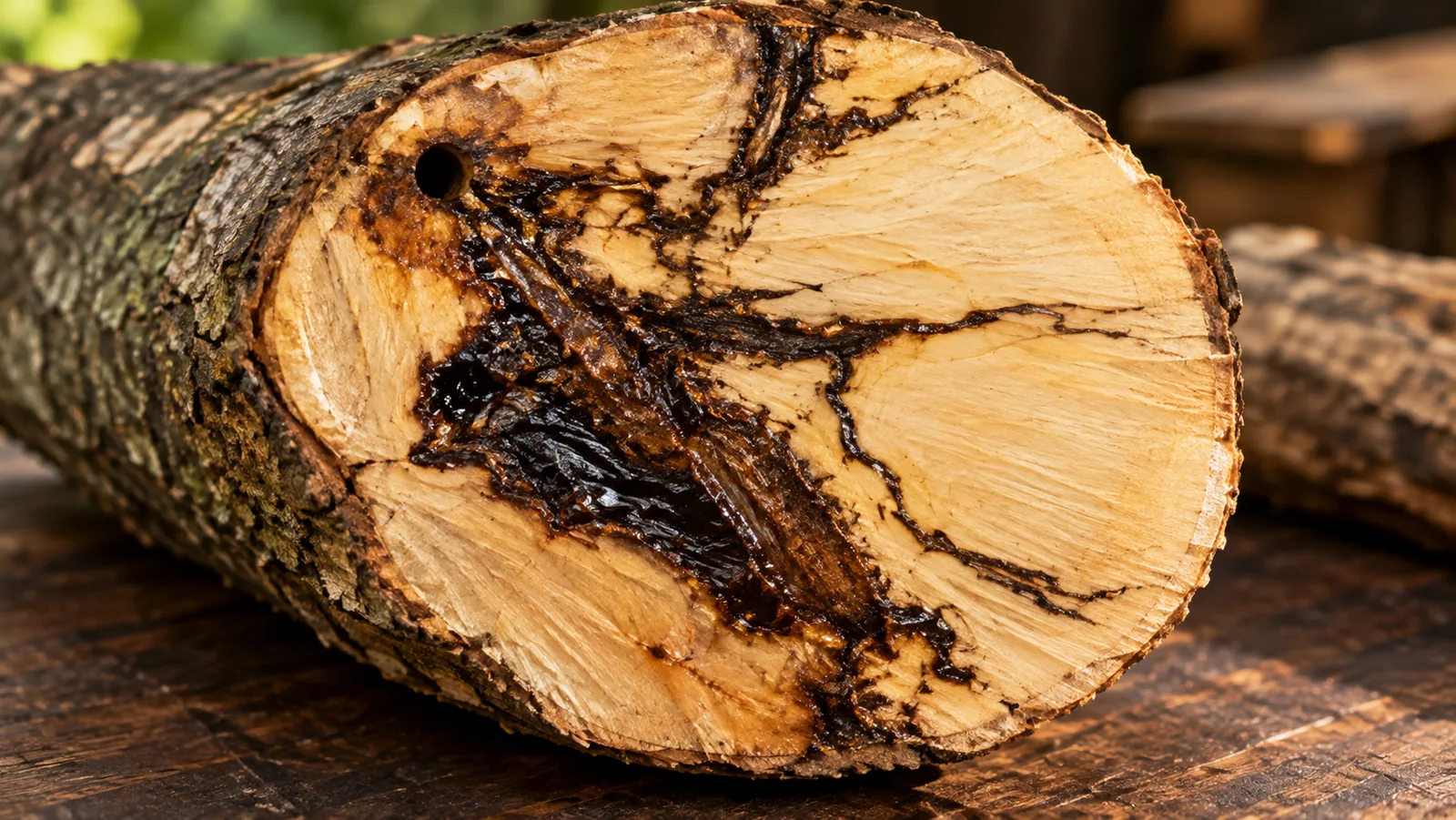
Insider tip: the hand-cleaning in step 6 takes huge patience. Workers scrape away pale wood with small knives, sometimes for days, to leave only the dark resin. Much of the price of good chips is this labour, not just the wood.
6. How Long Does an Agarwood Tree Take to Make Oud?
There is no single answer, because it depends on whether the resin forms naturally or is induced by people.
- Natural (wild) agarwood: forms slowly over many years, often decades, in old trees. This is the material behind the most famous old “qadeem” oils and chips.
- Induced agarwood: in field studies, a resin zone appears within about a month of inoculation and expands over 3–6 months; researchers commonly check trees at 6, 12 and 24 months.
- Tree age: farmers usually wait until a planted tree has a thick enough trunk before inducing it. Assam planters talk about harvests around 15 years after planting for the best returns.
The simple rule: time builds quality. A tree harvested one year after inoculation will have thin, light resin. A tree left for many years — or wild wood that formed over decades — gives denser, darker and more complex oud.
Insider tip: when a seller says a chip is “qadeem” (old), ask whether they mean old wood, old stock or an aged oil. Honest sellers will tell you clearly. You can read more in our Cambodian vs Indian oud guide.
7. Where Does the Agarwood Tree Grow?
The agarwood tree is native to the warm, wet forests of South and Southeast Asia, from India’s Northeast across to Papua New Guinea. It does not grow naturally anywhere in the Arabian Peninsula — yet the Gulf is one of the world’s biggest buyers of agarwood. A TRAFFIC study reported by Gulf News found UAE agarwood chip imports rose from about 56 tonnes in 2004 to more than 162 tonnes in 2007.
| Region | Main species | What the trade calls it | Typical scent character |
|---|---|---|---|
| Assam, Nagaland and India’s Northeast; Bangladesh | A. malaccensis | Hindi oud | Deep, earthy, smoky, often barnyard or leathery |
| Cambodia, Thailand, Vietnam, Laos | A. crassna | Cambodi oud | Sweet, fruity, honeyed, smoother |
| Malaysia, Indonesia (Sumatra, Borneo) | A. malaccensis, A. beccariana, others | Malaysian / Indonesian (Kalimantan, Merauke) | Woody, green, sometimes minty or spicy |
| Southern China | A. sinensis | Chinese / Hainan | Cool, sweet, delicate |
| Papua New Guinea, Philippines | A. filaria and others | Papua / Philippine oud | Bright, woody; varies a lot |
| Sri Lanka | Gyrinops walla | Silani / Sri Lankan oud | Light, sweet, fresh woody |
These descriptions are general trade patterns. Every batch differs with the tree, the soil, how the resin formed and how the oil was distilled.
Insider tip: the place name on a label tells you where the wood or oil was sourced, not always the exact tree. Ask your seller what they actually know about the origin, and trust shops that say “we don’t know” rather than inventing a story.
8. The Agar Tree in India’s Northeast: Assam and Nagaland
India’s Northeast is often called the cradle of the agar tree. Aquilaria malaccensis grows wild in Assam, Tripura, Arunachal Pradesh, Nagaland, Mizoram and Manipur. Our shop is named after Nagaland, one of these states, because Hindi oud from this region is part of the heritage we sell in Deira.
Assam is the centre of India’s agarwood trade, and some key facts from the Assam Agarwood Promotion Policy 2020 show its scale:
- A Forest Department study counted about 1.43 million agarwood trees in Assam’s non-forest areas (home gardens, farms and tea estates).
- About 91% of them are in four districts: Jorhat, Golaghat, Sivasagar and Hojai.
- Natural agarwood is mostly found in Golaghat, Jorhat and Sivasagar, where the native borer insect lives.
- The policy aims to plant 2.5 crore (25 million) saplings in five years and to make legal trade and export easier.
In May 2026, Assam shipped its first legally approved agarwood chip export to the Gulf: 112 kg in total — 100 kg to Saudi Arabia and 12 kg to the UAE — valued at about Rs 2.35 crore, with a CITES permit. That works out to an average of roughly Rs 2.1 lakh per kg (around AED 8,000 per kg), which gives you a real sense of what good chips are worth at source.
Insider tip: the city of Hojai in Assam is famous for agar oil distilleries, and many families in the Gulf oud trade have links to it. When you smell a deep, smoky Hindi dehn al oud like our Kalakassi or Qadeem, you are smelling this region’s style.
9. Wild vs Cultivated Agarwood Trees
Because wild trees have been heavily cut, most agarwood now traded comes from plantations. Both can produce real agarwood, but they are not the same.
| Wild agarwood | Cultivated (plantation) agarwood | |
|---|---|---|
| How resin forms | Naturally, by insects, fungi, storms | Mostly induced by drilling and inoculation |
| Time to form | Many years to decades | Months to a few years after induction |
| Resin density | Can be very dense; often sinks | Usually lighter; quality rising every year |
| Scent | Deep, complex, long-lasting | Cleaner, simpler; good for daily use |
| Availability | Very rare | Growing supply |
| Price | Highest | Lower to mid; top plantation grades still costly |
| Legality | Strictly controlled; needs CITES permits | Easier to trade legally with proof of origin |
Insider tip: plantation agarwood is not “fake”. It is real resin from a real Aquilaria tree. The honest question is not “wild or farmed?” but “how much resin, how old, and is the price fair for that grade?”
10. What Is Inoculated Agarwood, and Is It “Real”?
Inoculation means helping the tree do what it would do in nature, but faster and in more trees. Farmers drill holes into the trunk and either leave them as wounds or add a fungal or chemical inducer. The tree reacts by making resin around each hole.
- Wounding: chopping, nailing, drilling holes or partly breaking the trunk.
- Fungal (biological) inoculation: introducing fungi that naturally cause agarwood; researchers call this the safer and more popular method.
- Chemical inducers: substances that trigger the tree’s defence response.
The result is real agarwood: the same type of resin, made by the same tree. The difference is usually age and density. Freshly induced wood has lighter resin than wood that formed over decades in the wild.
Insider tip: what is fake is ordinary wood painted, soaked in synthetic oil or injected with heavy material to look like agarwood. Burn a small piece: real agarwood melts and bubbles its resin and gives sweet, oily smoke, while dipped wood often smells sharp, perfumy or like plain burning wood after the coating is gone. Our guide on how to burn oud chips and bakhoor shows the right way to test at home.
11. Is the Agarwood Tree Endangered?
Yes. Heavy cutting for agarwood has wiped out many wild trees. The key facts:
- CITES: Aquilaria malaccensis was listed in CITES Appendix II in the 1990s, and in 2004 all Aquilaria and Gyrinops species were added. Appendix II means trade is allowed, but only with permits showing it is legal and sustainable (CITES document).
- IUCN Red List: Aquilaria malaccensis is assessed as Critically Endangered in the wild.
- The UAE: as a CITES member and one of the largest importers, the UAE requires exporters to hold valid CITES permits.
What this means for you as a buyer: buy from a licensed shop that can explain where its stock comes from. Plantation-grown agarwood takes pressure off the last wild trees, and it is a good choice for everyday burning.
Insider tip: if you plan to carry agarwood across borders, especially large amounts, check the CITES and customs rules of both countries first. Keep your shop invoice.
12. Agarwood Tree Price 2027: Sapling, Tree and Wood
“Agarwood tree price” is one of the most searched questions about this tree, and the answers online are often wildly exaggerated. Here is the honest picture.
| What you buy | Typical price (2026–2027) | Honest note |
|---|---|---|
| Agarwood sapling (India) | Around Rs 100 and up from nurseries; online listings cost more | Cheap — the value only comes many years later |
| Standing tree, no resin | Little more than ordinary timber | A big tree with no resin has very low value |
| Standing tree with resin | No fixed price; depends on the resin found when cut | Buyers often pay a share of the harvest, not per tree |
| Agarwood chips at source (Assam, 2020 policy) | Rs 15,000 – Rs 2,50,000 per kg | Roughly AED 580 – 9,600 per kg by grade |
| Legal export average (Assam, May 2026) | About Rs 2.1 lakh per kg | About AED 8,000 per kg |
| Top-grade wild wood and oil worldwide | Over US$ 30,000 per kg | Rare, sinking grades and aged oils |
| Agarwood chips in our Deira shop | AED 75 – 420 per 12 g | From everyday Hindi to rare Kalagasi |
| Dehn al oud in our shop | AED 850 – 1,500 per 12 ml | Hindi, Kalakassi, Seufi and Cambodi oils |
Please note: these prices are a general guide only, checked in October 2026. Market and source prices (India, export and worldwide figures) come from the public sources linked in this article and are shown for information only; they are not our prices or an offer to sell. Agarwood prices change often with grade, stock, season and exchange rates. Rupee values are converted at about Rs 26 per AED (October 2026) and rounded.
Why does the price range so widely? Because the price depends on resin, not wood:
- Resin content: more resin means heavier, darker, more fragrant wood.
- Origin and species: some origins are rarer or more prized.
- Age: naturally aged wood beats freshly induced wood.
- Cleaning and grading: hand-cleaned pieces with no pale wood cost more.
- Sinking: wood dense enough to sink in water is the top grade.
Insider tip: be careful of social media posts promising crores from a few trees. A tree can be worth a lot, but only if it has formed good resin, and that is never guaranteed. Our full agarwood chips price list is always on our shop page.
13. Can You Grow an Agarwood Tree at Home or in the UAE?
You can grow the plant, but growing oud is a different story.
- Climate: the agarwood plant likes heat and humidity, rich soil and regular water. The UAE has the heat but very dry air, salty soils and little rain, so outdoor trees struggle.
- Indoors: a young agarwood plant can live in a pot with shade, humidity and regular watering, much like other tropical house plants. It will look nice, but it will not make oud.
- Time: even in perfect places, a tree needs years to grow thick enough to induce, then more years to build good resin.
- Rules: importing live plants or seeds needs plant-quarantine approval, and for Aquilaria also CITES paperwork.
Insider tip: if you love oud and want something “from the tree”, a small jar of good chips and a madkhan burner will give you more joy in one evening than a potted plant will in ten years.
14. Is Planting Agarwood Trees a Good Investment?
Agarwood planting can be profitable, and governments in India, Malaysia, Thailand and elsewhere support it. In Assam, planters have spoken of planting about 4,320 trees per hectare and very large returns after 15–16 years. But please read these numbers as hopes, not promises.
- Long wait: 10–15 years or more before the best harvest.
- Uncertain resin: induction quality varies; some trees give little.
- Skills needed: correct inoculation, harvesting and grading are specialist work.
- Paperwork: legal sale and export need registration and CITES permits.
- Scams: “agarwood investment” schemes that promise fixed returns from trees you never see have cost people money in several countries.
Insider tip: the best agarwood investments we have seen are by farmers who already live in agar-growing regions, plant on their own land as one crop among others, and learn from established growers. Buying “trees” online from far away is a very different thing.
15. From Tree to Majlis: Chips, Dehn Al Oud and Bakhoor
Once the resin wood is harvested, it becomes the three things you see in every Gulf home:
| Product | How it is made from the tree | How you use it | Our price (from) |
|---|---|---|---|
| Agarwood chips (oud) | Best resin pieces, hand-cleaned and graded | Burned on charcoal or an electric burner | AED 75 per 12 g |
| Dehn al oud (oud oil) | Lower-grade resin wood is soaked, then distilled for days | A drop on skin or clothes | AED 850 per 12 ml |
| Bakhoor | Wood powder or chips blended with oils, sugar and perfume | Burned for a sweet, perfumed smoke | AED 55 |
| Oud perfumes | Oud oil or oud accords mixed with other notes | Sprayed like any perfume | AED 75 |
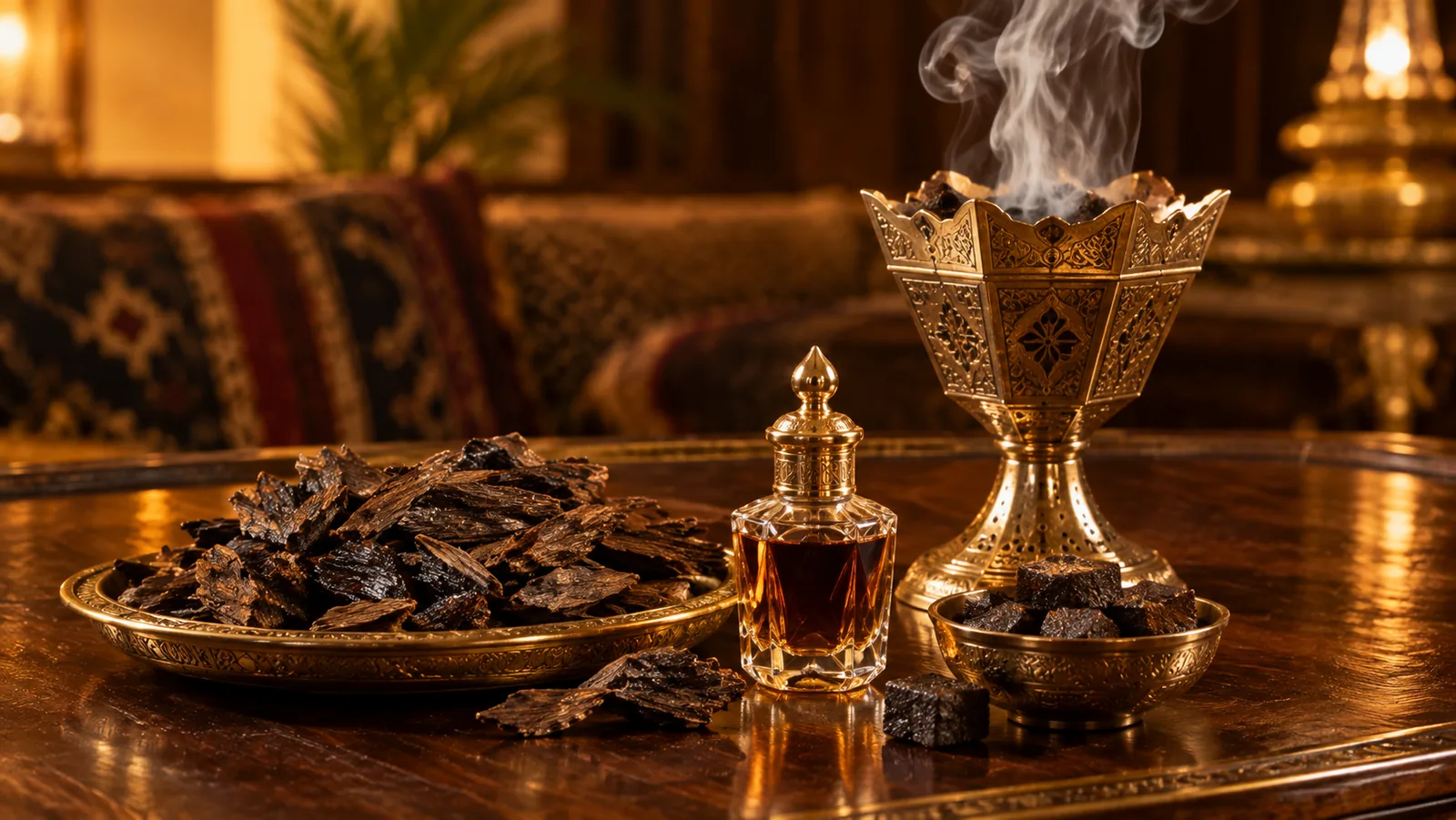
Distillation needs a lot of wood. Many kilos of resin wood are soaked and distilled to collect a small amount of oil, which is why pure dehn al oud costs far more per ml than most perfumes.
Insider tip: new to oud? Start with bakhoor or a mid-grade chip such as Royal Super Sallah Sufi before buying expensive oils. You will learn what you like for much less money. If you read Arabic, our Arabic guide to burning oud covers the same steps.
16. How the Tree’s Origin Changes the Scent
The same species can smell different from one country to the next because of soil, climate, the insects and fungi that cause the resin, and how long it matured. Very broadly:
- Hindi (Indian) oud: strong, deep, smoky and earthy. Loved by experienced oud lovers. Try Dagga Super Hindi chips or Oudh Sultan Nagaland.
- Cambodi oud: sweeter, fruitier and smoother. Easy for beginners. Try VIP Jar Cambodian or Cambodi Muattaq oil.
- Kalagasi / Kalakassi: a prized, rich and long-lasting style. Try Kalagasi Triple Super.
- Seufi: a classic, balanced Indian style. Try Seufi Qadeem oil.
For a side-by-side comparison, read our full guide: Cambodian vs Indian oud: how the aromas differ (also in Arabic).
Insider tip: smell oud on a warm burner, not cold in the jar. Cold chips hide most of their character. When you visit us, ask to smell a piece warm before you buy.
17. How to Buy Real Agarwood With Us in Deira
We sell agarwood chips, dehn al oud, bakhoor and oud perfumes from our shop in Deira, and online with delivery across the UAE. You are welcome to smell before you buy.
| Product | Size | Price |
|---|---|---|
| Dagga Super Hindi agarwood | 12 g | AED 75 |
| Oudh Sultan Nagaland – Indian agarwood | 12 g | AED 145 |
| Royal Super Sallah Sufi | 12 g | AED 160 |
| Oudh Al Maliki Visa Moori | 12 g | AED 350 |
| VIP Jar – Premium Cambodian | 12 g | AED 360 |
| Kalagasi Triple Super | 12 g | AED 420 |
| Dehn Al Oudh Kalakassi | 12 ml | AED 850 |
| Dehn Al Oudh Qadeem | 12 ml | AED 1,000 |
| Dehn Al Oudh Seufi Qadeem | 12 ml | AED 1,200 |
| Dehn Al Oudh Cambodi Muattaq | 12 ml | AED 1,500 |
| Madkhan burners | 1 piece | AED 45 |
| Bakhoor | 1 pack | AED 55 – 90 |
Prices can change: the prices above were taken from our website in October 2026 and are for guidance only. They may change at any time without notice because of stock, grade, new shipments and market rates. The final price is always the one shown on the product page or confirmed by our team when you order. Trade and wholesale buyers can ask for our wholesale catalogue.
Get Today’s Price on WhatsApp
Agarwood prices move with every new shipment. Send us a message on WhatsApp +971 55 736 2840 with what you are looking for — chips, oil or bakhoor, and your budget — and we will reply with today’s best options, photos and a fixed price.
Get Your Perfect Oud in Just 3 Steps
- Tell us what you like: strong and smoky (Hindi), sweet and smooth (Cambodi), or not sure yet.
- Smell before you buy: visit our Deira shop or ask for a short video on WhatsApp.
- Collect or get delivery: pick it up in Deira or order from our online shop with delivery across the UAE.
Your Agarwood Buying Checklist
- Does the seller explain the origin (Hindi, Cambodi, Malaysian…) honestly, or just tell a story?
- Is the wood dark and resinous all through, not just painted on the surface?
- Does a small piece bubble and give sweet, oily smoke on a burner?
- Is the smoke smooth after a few minutes, without a sharp chemical smell?
- Is the price fair for the grade (see the price table above)?
- Is the shop licensed in the UAE, with a proper invoice?
- Can you smell it warm before paying?
- For oils: does the seller tell you the size in ml and let you test a drop?
Summary: A Simple Way to Think About It
The agarwood tree is the factory; resin is the product. A healthy tree is ordinary wood. A wounded, infected tree slowly turns its wood into oud. Wild resin is rare, deep and expensive; plantation resin is real, cleaner and more affordable. Buy for the resin, not the story.
Frequently Asked Questions
What is the agarwood tree called?
The agarwood tree is the Aquilaria tree. It is also called the oud tree, agar tree, aloeswood, eaglewood and, in Malaysia and Indonesia, gaharu or karas.
Does every agarwood tree have oud inside?
No. A healthy agarwood tree has pale wood with no oud. Oud resin forms only after the tree is wounded and infected, and only about 7–10% of wild trees contain it.
How long does an agarwood tree take to produce oud?
In the wild, good agarwood forms over many years or decades. In plantations, resin starts to appear within months of inoculation, but growers usually wait years for denser, better-quality wood.
What is the price of an agarwood tree?
A sapling in India costs from around Rs 100. A grown tree has little value without resin; with resin, it is priced by the agarwood harvested, which ranged from about Rs 15,000 to Rs 2,50,000 per kg at source in Assam. These figures are a guide only and prices change often.
Where does the agarwood tree grow?
It is native to Northeast India, Bangladesh, Myanmar, Thailand, Cambodia, Laos, Vietnam, southern China, Malaysia, Indonesia, the Philippines and Papua New Guinea. It does not grow naturally in the Arabian Peninsula.
Is the agarwood tree endangered?
Yes. All Aquilaria species are listed in CITES Appendix II, and Aquilaria malaccensis is assessed as Critically Endangered on the IUCN Red List. Legal trade needs CITES permits.
Can I grow an agarwood tree in Dubai?
You can keep a young plant indoors with shade, humidity and regular water, but the UAE climate is too dry for healthy outdoor trees. A home plant will not produce oud without many years of growth and induction.
Is plantation or inoculated agarwood real oud?
Yes. It is real resin made by a real Aquilaria tree. It is usually lighter and younger than wild agarwood, so it costs less. Fake agarwood is ordinary wood painted or soaked in oil.
What is the difference between Hindi and Cambodi oud?
Hindi oud comes from Indian agarwood trees and smells deep, smoky and earthy. Cambodi oud comes from Aquilaria crassna in Cambodia and nearby countries and smells sweeter and fruitier.
Why is agarwood so expensive?
Because few trees form resin, resin takes years to mature, wild trees are protected, and hand-cleaning the wood takes a lot of labour. Top grades can sell for more than US$30,000 per kg.
Does the agarwood tree smell good?
Not on its own. Healthy agarwood wood smells like ordinary green wood. The famous oud smell comes only from the resin, and it is strongest when the resin wood is warmed or burned.
Where can I buy real agarwood in Dubai?
You can visit Nagaland Agarwood & Incense Trading in Deira, Dubai, where you can smell chips and oils warm before you buy, or order online at nagalandoudh.com with delivery across the UAE.
Before You Go
The agarwood tree teaches a simple lesson: the most beautiful scent in the world is born from a wound. A tree that is hurt, slowly, patiently, turns its pain into something people have treasured for more than 2,000 years. When you light a small piece of oud for your guests, you are burning years of a tree’s life.
That is why we believe agarwood should be sold honestly — with the real origin, the real grade and a fair price. Whether you want a small jar for your home or oils for a special occasion, we are happy to guide you, even if you only come to smell.
Buy for the resin, not the story.
Visit us or message us today
Nagaland Agarwood & Incense Trading L.L.C
Shop 106, M-Floor, Ahmed Mohamed Ali Kamal Bldg, Sikkat Al Khail Rd, Al Daghaya, Deira, Dubai
Important note: This article is for general information only. All prices, figures and market values are approximate, were checked in October 2026, and can change at any time without notice. Prices from other markets and sources are quoted from the public sources linked above and are not offers from Nagaland Agarwood & Incense Trading L.L.C. Nothing in this article is legal, investment, financial or medical advice. Rules on trading, carrying or importing agarwood (including CITES and customs) can change, so always check with the relevant authorities before buying, planting, investing or travelling with agarwood.
Leave a Reply